8 Weeks Pregnant
Development of your baby in pregnancy week 8
Nervous system development
This week is vital for the brain development of the fetus as the nerve cells branch out and connect with each other to form primitive neural pathways [2]. The taste buds also start to form [3] with the spinal cord also continuing to develop during the 8th week [4].
Facial development
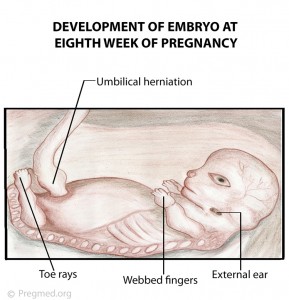
This is the week when your baby’s facial features (eyes, nose and lips) begin to develop [4]. Pigment starts to form within his eyes along with the eyebrows, which may make them appear to be open [5].
Limb development
His arms and legs are also getting longer [6] with the hands folding at the wrists and elbows while his body begins to straighten. However, the thighs, knees and toes are not formed yet [1]. The tiny tail visible last week is almost gone along with the thin webbing of the fingers and toes [3]. Your baby has actually started moving this week, but it is still too early for you to feel it.
Internal organ development
The heart divides into the left and right chambers, developing distinct aortic and pulmonary valves [4], beating about 150-160 times per minute (twice the heart rate of adults) [7]. The developing lungs start growing branches that connect with the breathing tubes extending from your baby’s throat [8]. The pituitary gland, liver and kidneys start developing while the muscle fibers, bones and cartilage begin to grow as well. This is also the week when the blood type of your baby is determined and the liver takes over the job of producing the blood cells (previously done by the yolk sac) [7].
8 weeks pregnant: how big is your baby?
Your baby is now around 1.6 cm in length, about the size of a medium raspberry. [9]
What happens in your body during pregnancy week 8?
You may have started noticing certain changes in your body by this time. Your body has already started to prepare for breastfeeding your baby, which causes your breasts to appear larger than normal [9].
What does 8 weeks pregnant look like?
Your belly may be expanding a little while you may even feel the enlarging uterus (it is as big as a softball by this time) if you gently press your abdomen [10]. But, you will not start showing just yet [11].
Pregnancy week 8 ultrasound scan
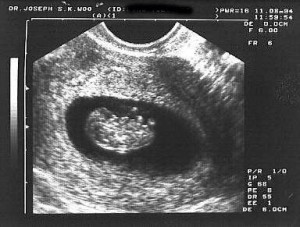
A hint of the upper lip, the tip of the nose and the eyelids become visible on ultrasound along with two tiny ears. [12]. In most cases, the beating heart can also be seen by this stage. But, it is still too early to determine the baby’s gender through ultrasound [5].
Pregnancy symptoms at 8 weeks
All the symptoms of early pregnancy and morning sickness continue in the eighth week with nausea, vomiting, headache and dizziness being the most common. Having the symptoms of morning sickness generally indicates a healthy pregnancy [11]; however, it is also normal to have no symptoms at this stage. The main symptoms at week 8 are:
- Fatigue and tiredness
- Bloating [13]
- Flatulence
- Constipation
- Frequent urination
- Heartburn
- Breast tenderness [14]
- Shortness of breath
- Increased appetite
- Emotional changes
- Food cravings/aversions [15]
- Anxiety
- Backache
- Feeling excessive hunger and thirst
- Nasal congestion
- Abdominal pain [10]
- Round ligament pain (more common in second or subsequent pregnancy)
- Heightened sense of smell [3]
- Lightheadedness
- Clothes starting to get a bit tight
- Belly starting to harden up (rare, but harmless at this stage)
- Trouble sleeping (insomnia)
- Itchy legs, hands and belly
- Joint pain [20]
When to call the doctor?
Make sure to call the doctor in case you experience any of the following symptoms as they may result from complications like ectopic pregnancy, preeclampsia (high blood pressure), loss of pregnancy and a kidney or yeast infection:
- Severe abdominal or lower back pain or cramping (especially on the right side)
- Heavy vaginal bleeding or spotting [16]
- Passing blood clots or tissues (might indicate miscarriage)
- Fever with temperature over 102° F [17]
- Cold and flu or symptoms of influenza
- Extreme breathing difficulty
- Whitish, greenish, yellow or clear discharge with or without an odd smell, along with pain while urinating (might indicate a bacterial infection) [18]
- Extreme nausea and vomiting
- Starting to show already (might indicate amniotic fluid related complications) [21]
- Extreme fatigue
- Rapid weight gain or loss
- Severe headache or migraine (especially if you do not have a history of migraine)
Tips for a healthy pregnancy and baby
- Contacting your doctor to schedule a prenatal visit if unless you already have an appointment
- Quitting smoking and drinking altogether
- Drinking plenty of water (at least 8 glasses a day, even if it means more trips to the toilet)
- Making sure to include plenty of healthy calories to your diet as you need 300 extra calories per day (600 if you are expecting twins) while pregnant [15].
- Following a diet containing lots of fruits and vegetables rich in vitamin C and folic acid
- Talking to your doctor regarding any worries or concerns you may have about your weight (as it is not ideal to start a diet in the first trimester) [5]
- Wearing maternity support bras instead of your regular ones as they provide extra support and comfort
- Taking lots of rest if you are feeling more tired or sleepy than normal (the pregnancy hormones and increased blood volume are usually responsible for these symptoms)
- Regular exercise to keep the muscles toned, preparing them for the body changes to come [14]
- Eating multiple small meals to fight indigestion [19]
- Drinking a glass of milk whenever experiencing heartburn
- Consulting your doctor if considering taking paracetamol (Tylenol) or antacids to manage certain symptoms
- References +
- http://www.nhs.uk/conditions/pregnancy-and-baby/pages/pregnancy-weeks-4-5-6-7-8.aspx#close
- http://www.nhs.uk/conditions/pregnancy-and-baby/pages/pregnancy-weeks-4-5-6-7-8.aspx#close
- http://pregnant.thebump.com/pregnancy-week-by-week/8-weeks-pregnant.aspx
- http://www.parenting.com/timeline/1st-trimester-week-8
- http://www.bounty.com/pregnancy/8-weeks-pregnant
- http://www.mayoclinic.org/healthy-living/pregnancy-week-by-week/in-depth/prenatal-care/art-20045302?footprints=mine&pg=2
- http://www.baby2see.com/development/week8.html
- http://www.babycenter.com/6_your-pregnancy-8-weeks_1097.bc
- http://www.babycentre.co.uk/8-weeks-pregnant
- http://www.babyzone.com/pregnancy-week-by-week/8-weeks-pregnant_70643
- http://www.whattoexpect.com/pregnancy/week-by-week/week-8.aspx
- http://www.parents.com/pregnancy/week-by-week/baby-development/#page=8
- http://www.bellybelly.com.au/pregnancy-week-by-week/8-weeks-pregnant#.UxrhYT-Sz_A
- http://www.webmd.com/baby/guide/your-pregnancy-week-by-week-weeks-5-8
- http://www.parents.com/pregnancy/week-by-week/8/
- http://www.webmd.com/baby/tc/pregnancy-when-to-call-a-doctor
- http://www.parents.com/pregnancy/week-by-week/8/cold-flu-and-allergy-remedies/
- http://www.babycenter.com/0_vaginal-discharge-during-pregnancy_270.bc
- http://www.justmommies.com/articles/eight-weeks-pregnant.shtml
- http://pregnant.thebump.com/pregnancy/pregnancy-symptoms/articles/joint-pain-during-pregnancy.aspx
- http://www.pregnancy-weekbyweek.com/pregnancy-week-8.htm